Monday, August 31, 2026

A Session at The Bike Fitter!

Background Story:

I'm mostly a mountain biker and spend a lot of time out of the saddle, so I never really considered doing a bike fit before. However, 2026 is the 10-year anniversary of my road biking group, the Tuesday Turtles, and we've been spending the whole summer working through a 16-week training program, culminating in a one-day 100-mile ride in October. I've been riding with the group now for 6 years, and two years ago, I upgraded from a 2013 Cannondale Synapse 105 alloy to a 2019 Carbon Synapse Disc Ultegra, which I LOVE. Unfortunately, I've been getting tingly fingers, numb hands, neck/shoulder pain, and saddle sores as our weekly mileage has increased.

After talking to a couple other people, I made an appointment for a road bike fit with Mark Gerlando at Ride Science in Traverse City. I figured the bike mostly fit me, and I'd just need a few tweaks, but I scheduled the "Full Fit" just in case. The morning of my appointment dawned, and I loaded up my road bike for the fit, and my mountain bike for a ride after. In the appointment reminder email, I was instructed to wear my usual biking clothes, and to bring my shoes, helmet, gloves, Camelback, and anything else I usually wear for riding.

The Process: 

Mark pulled into the parking lot just minutes after I did, and he had me bring BOTH bikes in. He pulled the rear wheel off the road bike and mounted it up to the trainer/sensor, while I filled out some paperwork about my bike, goals, physical issues, etc. After he had my bike set up, he grabbed both pair of shoes I brought (one pair of SPD sandals and one pair Specialized road shoes), and immediately moved the cleats all the way to the back of the slots. This was the only thing he did that he didn't explain to me, so asked "Dr. Google", and got this:

Key Benefits of Moving Cleats Back
  • Better Comfort and Less "Hot Foot": Traditional placement under the ball of the foot puts pressure on the springy metatarsal joints, which can cause numbness or a burning sensation. A rearward position moves the pressure onto the solid bony heads of the metatarsals, offering more support. [1, 2]
  • Reduced Calf and Achilles Strain: Opinions on TrainerRoad show a consensus that rearward cleats decrease the ankle's range of motion and reduce the workload on your calf muscles and Achilles tendons. [1, 2]
  • Improved Stability: Moving the cleat back shortens the effective lever arm of the foot, making it easier to maintain a stable ankle angle during your pedal stroke without wasting energy. [1, 2]
Important Bike Fit Adjustments
When you shift your cleats backward, your foot moves further forward relative to the pedal axle, which effectively increases your leg extension. [1, 2]
  • Lower Your Saddle: As a general rule, lower your saddle slightly (about 5 mm for every 10 mm you move the cleat back) to compensate for the extra reach. [1, 2]
  • Adjust Saddle Setback: You may also need to nudge your saddle forward by a small amount to keep your knee and hip alignment feeling natural. [1, 2]

 Once he had that done, he had me slip the sandals on, climb up on the platform, hop on the bike, and start pedaling. In front of my bike, on the wall was a very large monitor with an instantaneous pedal power graph showing cadence, power, and where in the stroke the power levels are happening (plus a bunch of other stuff that would be appropriate for a competitive cyclist, but was more than I needed to worry about). He watched me pedal for a few minutes, while I watched the numbers and the moving graph on the screen. With my current set up and new cleat position, my power numbers ranged from low 90s to around 101, and the peak was happening before my feet hit the 3:00 position. I could really feel my saddle sores along the crease of my left leg.


 Lots of pedaling, hopping off, adjusting seat position and handlebar rotation, hopping back on, and more pedaling ensued. I watched as the power peak slid closer to the 3:00 position, and I could feel my shoulders and arms relaxing and my pedal stroke feeling smoother.

 Next up was the addition of the saddle pressure sensor. He had me stand up while "coasting" so he could slide it over my saddle underneath me. Then he had me sit back down and pedal some more. More pedaling and hopping, but this time, I slid over to his desk to look at the saddle pressure heatmap on his monitor. It showed that my pelvis is angled left hip forward a bit (likely from the cracked acetabulum I had), that I'm not sitting fully back on the saddle, that my pelvic center of mass was stuck in the bottom right side of the graph, and that there were really obvious red "hot spots", especially along the left side. It turns out that the Terry Butterfly/Topo/Selle Italia LDY saddles that I've had on every one of my bikes since they first came out in the late 1990s is simply no longer the right saddle for me and there are a LOT better options for my physiology. Besides being too wide and flat in the back, blocking me from using my hamstrings efficiently and pushing me forward constantly, it was too wide in the front, causing the saddle sores, too.

He went to his wall of saddles, and grabbed a few that were shorter, narrower, and more curved. More hopping and pedaling, as I watched my power numbers climb and my heat mapping improve with each saddle change. We finally settled on the Specialized Power Comp with Mimic in the 155 width. The heatmap was now almost fully green with just bits of yellow (no longer any red), my pelvis line was farther back, right where it should be, my pelvic center of mass was now moving freely to both sides of the saddle, and my power levels had jumped to the 130s. In addition, because my sit bones were fully supported (and I no longer had to keep pushing myself back), my shoulder and neck pain and tingly fingers were gone.


Finally, because he moved my cleats back, he had to lower my saddle and because my top tube is a bit too long (since I'm all legs and no torso), move it all the way forward.

Once we were all done with that, he "mapped" my bike, measuring and noting reach, stack, offset, and a bunch of other numbers so we can set my other and any new bikes the same way. Then he grabbed my mountain bike and checked the same measurements. We both had to chuckle because it was already set up within 3-5 mms of everything we had just done with the road bike. I still need to swap out saddles on that one, and we'll need to move the new saddle lower to account for the saddle stack height, but otherwise, it should be good to go.

We shook hands, I paid him (less than I expected because we didn't use the whole 2 1/2 hours), and he helped me wheel the bikes out to my car. I then cruised across town and hopped on the TART for a 20-mile test ride.

 The Verdict: 

As of right now, I'm going to call the fitting a complete success - my hands never got tingly, the saddle sores already there weren't noticeable, I never got fidgety, my neck and shoulders felt fine, and I climbed the eastern end hills easily. I'm to keep in touch with any issues as he guarantees his fits for a year, and any issues should show up this week as our program's training rides for this week are 20, 40, and 75 miles.

My Recommendation: 

If you ride bikes and have any discomfort at all, this is an amazing service! It doesn't matter if you're just a recreational rider or a competitive cyclist; I absolutely, 100%, recommend doing this. It was way more involved and enlightening than I ever expected.

The Specifics:

Owner/fitter: Mark Gerlando

Ride Science

129 E State St, Traverse City, MI 49684

Website: https://www.ridescience.com/


Thursday, March 12, 2026

2026-2027 Salomon, Atomic, Head, Rossignol, Stockli, and Black Crows Demo Day

Tester:

Kris: 60-year-old who prefers finesse and technique over power, and has a love of high speeds and junky snow. Ex-PSIA level 2 instructor, Beer League and NASTAR racer.

Conditions:

Solidly frozen groomers with a fine dusting of sugar on top in the morning, breaking down into soft slush bumps and chunk by lunch. Sunny and warming, with increasing wind in the afternoon.

Skis listed in the order tested
 
Stockli Laser SC, 164 cm, 120-70-102, R=13.8 m:

I managed to hop on the SL CPT last year and found it to be a fairly demanding short turn specialist. The SC adds a bit of width underfoot and in the tail, and it feels a bit softer and more sprightly. It was fun and zippy when driven from the front, but it's still fairly stiff and can feel cranky and unforgiving if your technique is off. Racers and strong advanced/expert skiers who like short turns will likely love this ski.


Stockli Montero AS cm, 172, 127-74-107, R=14.8 m:

The Montero AS is another damp, smooth Stockli; but damp and smooth doesn't equate to stiff or hard to ski in this one. It can be coaxed into short turns and slow speeds, but its happy place is medium to long turns at eye-watering speeds. The AS had no problems with frozen groomers or the increasing piles of spring slush later in the day. This ski is strong enough that you could size down with very little loss in stability, but a decent gain in maneuverability.
Salomon Addikt 66 Pro, 170 cm, 120-66-104, R=15 m:
 
Whoa!!! All the stability and guts of a slalom race ski with a huge dose of fun! How did they DO that??? Poppy and grippy, this is the most fun I've had on a slalom ski in a long time. Advanced and expert skiers will get the most from the Addikt 66 Pro, but it really is accessible enough for upper intermediates to learn the joy of short turns. I spent the whole time on it just grinning and giggling. This was one of the 2 winners of the year for me.
Head Kore 93 Ti, 163 cm, 128-92-114, R=13.3 m:
 
 I've tried multiple versions of the Head Kore and Joy over the years, and I've hated all of them except the Wild Joy. I always found them to be too light and stiff to be anything other than rattly and jarring—until now. Head has added metal to their Kore line, which effectively and quite nicely dampened the behaviors I liked the least. I found the 93 Ti to be most comfortable in medium and long turns, and it lacked grip on the firm morning groomers when pushed, but was super forgiving and perfectly happy to cruise around at "normal person" speeds. The 163 was noticeably too short and too soft for me. This is a great ski for intermediates and chill advanced skiers to begin exploring the whole mountain.


Head Discovery 86 Pro, 170 cm, 130-86-113, R=15.2 m:
 
Ho-ly-cow!!! The Discovery series is built with Auxetic material and Spaceframe construction, which sounds like a bunch of silly marketing technobabble. What it means on the hill, though, is massive amounts of fun for everyone. The Auxetic material stiffens the ski as you put more force into it, so the ski starts out as a mellow, easy going, go anywhere ski; it stays damp as the speeds and forces pick up; and turns into a powerful, bouncy, "Wheeeee!!!" fest when it's really driven hard and fast. Every run had me giggling and woo-hooing as we rolled into the lift maze. I had my fastest run of the day on the 86 Pro, even in the developing afternoon slushy crud. It felt really weird to check all 3 boxes for Nimble, Balanced, and Burly on my ski scorecard, but it was absolutely true for this one.
 
This was my other winner of the day and I would LOVE to replace my aging RTM 84s and Fischer Hybrid 8.0s with the 86 Pro.
Rossignol Super Arcade 94, 178 cm, 138-94-127, R=15 m:


I have to admit I only tried these because of the color, but I was surprised by just how strong this ski is. If you're an aspiring big mountain skier, or prefer to deal with spring crud by blowing through it at speed, this is your ski. Short turns? No. Slow speeds? Again, no. Medium turns? Maybe, but why?? Point em downhill, put the pedal to the metal, and hang on! There is a small chance that my impression of big and burly is a function of the length (178), but I really don't think so. I seriously wish I'd had a chance to ski it back-to-back with the standard Arcade 94 to see if there was a detectable difference.


Atomic Redster Q9.8, 173 cm, 134-84.5-118.8, R=14.4 m:
 
The Q9.8 is another hard charging race-based ski, with enough waist width to make it a versatile all mountain ride for strong skiers. It's on the burly end of the flex spectrum and lacks forgiveness, especially at slower speeds. Even with the 14 m turn radius in the 173 cm, it excels at medium and long turns and stays glued to the snow. The width dimensions and turn radius for the Q9.8 vary by ski length.


 Salomon QST 94, 164 cm, 132-94-118, R=14.5 m:
 
The QST is a nimble, forgiving ski for lovers of short and medium turns at more leisurely speeds. Its long tip rocker and soft flex makes it quick, poppy, and extremely versatile in softer snow. Even with the redesigned tail, the soft flex and easy going nature means it suffers a bit on harder groomers. The 164 cm length felt distinctly too short for me, leaving me wishing for more length, more stiffness, and more rebound. This is another winner for more relaxed skiers who want to start exploring the whole mountain.


 Thank you again to the reps for Stockli, Atomic, Salomon, Head, Rossignol, and Black Crowes, and the crews from Bill & Paul's Sporthaus and Caberfae Peaks for making this such an amazing event every year!!

Tuesday, March 11, 2025

2025-2026 Salomon, Atomic, Head, Rossignol, Stockli, and Black Crows Demo Day

Tester:

Kris: 59 year old who prefers finesse and technique over power, and has a love of high speeds and junky snow. Ex-PSIA level 2 instructor, League and Nastar racer.

A side note for this year - I've spent the last few years feeling out the offerings from Atomic, Salomon, Head, and Rossignol, so when they added Stockli and Black Crows to the line up this year, I spent a majority of my time at those tents.

Conditions:

Solidly frozen groomers with a fine dusting  of sugar on top in the morning, breaking down into soft slush bumps and chunk by lunch. Sunny and warming, with increasing wind in the afternoon.

Skis listed in the order tested

Atomic Volant 7000, 173 cm, 128.5-77-106, R=15 m:

Break out your Windex and Pledge, ladies and gents.....Volant is BACK!! Atomic has brought them back from the dead with a snazzy new charcoal top sheet and the same great performance. This ski is absolutely solid, unshakable, and buttery smooth, and none of us found its speed limit. It can be pushed into semi-short turns, but you're doing yourself and the ski a disservice if you do. Instead, roll this ski on edge, put the pedal to the metal, and just stand there grinning foolishly while it takes you for an adrenaline-fueled ride. I skied it on early morning crust, while others skied it later in the day, but it maintained its composure regardless of the conditions. There are 3 models of the ski, and this is the middle one. The sidecut dimensions change based on the length of the ski.
 
This is a premium ski, so I suggest you don't demo it without significant funds because you WILL want to own it. 


Stockli Laser SL CPT, 165 cm, 120-66-98, R=13.6 m:
 
This year, my entire race team was on Stockli race skis and they all went on and on about how awesome they are, so I HAD to try these out. I had demoed Stockli Stormriders previously and really wasn't impressed, so I didn't understand the hype. After riding these, I totally get it now! They are super damp and compliant, but a bit unforgiving. Driving the tips really brought them around in short turns while skiing centered allowed them to rip medium turns just as easily, but make no mistake these are short turn specialists with serious grip on hardpack and ice.
 
 
Stockli Laser GS CSC, 175 cm, 118-68-97, R=17.1 m:

This is another strong, damp ski that just loves to rip. The skis' dampness seriously mutes snow feel, keeping them firmly planted even on rough surfaces. This really encourages you to put all your weight on that outside foot, knowing nothing will shake that ski loose. All that grip is strangely tempered by their willingness to skid when requested and their forgiveness if your balance isn't always spot on. The strength of this ski means you could probably go with a shorter length than you would normally choose.
 
If I decide to step up to true race skis in the future, this will likely be my choice.


Atomic ARC 735, 175 cm, 114-65.5-99.5, R=15.2 m
 
Underneath the cool retro graphics is the heart and construction of the venerable Redster X9s, without the Revoshock dampener. This gives the ski the same level of fun and steadiness as the original X9s, but with less weight and a lighter, snappier feel. While it's a bit narrow for full all-mountain use, it's a total hoot on the groomers, even when they get a bit slushy and chewed up. That extra bit of pop makes even short turns fun.
 
Upper advanced and expert skiers who can rip a solid carve all over the mountain will get the most from this ski.
 
There's even matching poles, goggles, and a hat!
StockliMontero AW, 166 cm, 122-80-106, R=16.0 m
 
What a fun, nimble, and accessible ski! The AW has race ski construction and can carve up a storm when required, but it also has a softer side that makes it fun, snappy, easy going, and forgiving. I had a great time bopping around the slush bumps at the top of the run, then letting them loose on big screaming carves at the bottom. This is a great option for the burgeoning aggressive upper intermediate-advanced woman looking to perfect their centered stance and carving while maintaining the ability to piddle around when the snow gets deeper or messier without getting punished.
 
I did feel the 166 skied a bit short for me, as my usual daily drivers are 167 to 177 cm. Really strong skiers may want to size up.
Black Crows Captis Birdie, 166.2 cm, 127-90-113, R=17 m
 
The Captis Birdie is a women's specific ski that's fun and snappy in medium and short turns. It will do longer turns, but that's not its forte. It's light enough to bop around slush bumps and hang on for carves in softer snow, but that same light snappiness means it will get bounced around on true hardpack and in heavier snow. It's super nimble and forgiving, but skis a bit short. This makes it a great choice for intermediate skiers just starting to venture into crappier snow conditions. Stronger skiers will want to size up.
Black Crows Camox Birdie, 168.1 cm, 125-97-114, R=19 m
 
The Camox Birdie is another women's specific offering from Black Crows. It maintains the nimble poppiness and accessibility of the Captis with a touch more width. Like the Captis, it's a softer ski that tends to ski short and suffers a bit on true hardpack and ice. The Camox is a great choice for lighter aggressive skiers, or those just venturing off piste. It's soft tip and tails really sucked up and swiveled around the slush bumps in the afternoon.
 
Also like the Captis, stronger skiers will want to size up.

Huge thanks going out to Bill and Paul's Sporthaus for arranging this event, Caberfae Peaks for hosting (and feeding) us, and the reps Travis, Patty, Tom, Rick, Ryan, and Tony for sharing their wares, passion, and knowledge with us. This is my favorite ski day of the year, every year!!


Tuesday, March 19, 2024

2024-2025 Atomic, Rossignol, Head, and Salomon Demo Day

Tester:

Kris: 58 year old who has recently lost 96 lbs, prefers finesse and technique over power, and has a love of high speeds and junky snow. Ex-PSIA level 2 instructor, League and Nastar racer.

Conditions:

Solidly frozen groomers with a fine dusting on top in the morning, breaking down into chunky sugar over an ice base by lunch. Cloudy, cold, and crazy windy all day.

Skis listed in the order tested


Rossignol Essential, 167 cm, 122-69-103, R=12 m:

I got a chance to ski this ski last year, and it was the clear winner of the day for multiple people. I have since spent an entire year dreaming of taking this ski for another spin, so I went directly to the Rossi tent and asked for it first thing. Yup, it was everything I remember!. While Rossi considers the Essential an "all mountain" ski, I would call it a fairly dedicated detuned slalom ski; thus forgiveness is not her fortay. A tiny bit of tip pressure, and she whipped quickly into the turn. A touch of heel pressure, and she would sling right into the next turn. A subtle, centered stance even had her happily making medium and even longer turns. I was giggling from the very first run. I LOVE this ski!!!!! In fact, she went home with me and tuned into my daily driver even in deep spring glob.
 
Atomic Redster Q9.8 Revoshock, 181 cm, 136-85-120.5, R=15.2 m:
 
 
Chet got on this one while I made extra runs on the Essential, then I hopped on it. The Q9.8 in a 181 cm is a freakin freight train! They clung to the icy scratch and blasted through the chunky sugar. At this length, they were a bit balky in medium and short turns for me, while Chet's greater muscle mass means he had less trouble with them in shorter turns. I felt they were both too long and too stiff for me at 181. For really strong skiers with a love of speed, these would be a great choice.
Head World Cup e-SL RD, 153 cm, 112-64-97, R=Approx 12 m:
I asked the Head rep for something that would make me go "Yee Haw!", and they picked this little spitfire for me. It earned 5s in every category except long turns, crud, and forgiveness, which isn’t at all surprising given that it’s a full-on slalom race ski. This one is not for the faint of heart, but a technically proficient skier will be able to make it sing on the groomers. This one was another giggle-fest for me, though I would really like to have tried it in a longer length.


Rossignol Hero ST Ti, 167 cm, 123-68-104, R=13 m:

I really love what Rossi has been doing with their skis the last few years. The Hero ST Ti was perfect for me in the 167 cm. It was so confident and steady in all turn shapes. It rolled easily into short turns and released the turn equally easily. For a short turn specialist, it was surprisingly good in medium and long turns. It really likes speed, but doesn't get cranky when going slower. This isn't a super exciting ski, and it was somewhat lacking in rebound, but I think that's part of what made it so buttery smooth and confidence inspiring.


Salomon Stance 84, 167 cm, 112-84-105, R=15 m:

This women's specific ski was just plain easy, steady, and fun. It excelled in medium turns and handled short and long turns with almost equal aplomb. It also had great grip on the ice, but I found it lacking in some stability, especially at speed. It was super forgiving and would make a great ski for the intermediate just venturing into steeper terrain, trees, and bumps. The 167 felt a bit short for me and the flex felt a bit soft, so stronger or heavier skiers should size up on this one.


Atomic Redster Q9 Revoshock, 176 cm, 128-75-112, R=14.2 m:
 
 The Q9 was another super fun ski!With a slalom sidecut, GS construction, and a skinnier all mountain width, it was a carving machine. Make no mistake, this ski lacks forgiveness and needs a strong pilot with good technique and higher speeds to really sing. Short turns required lots of input, but medium and long turns left me with big grins. This one got a bit tossed around when running flat in the afternoon sugar.


Head Kore 85, 170 cm, 127-85-108, R=14.8 m:

I've been on earlier versions of Head's Kore technology, and really disliked their light weight and rattly feel. I thought I'd give them another shot, and super I'm glad I did. The Kore 85 was balanced and nimble and totally steady in the deeper sugar. It was incredibly forgiving, had great grip on the underlying scratch, and excelled at medium and long turns at speed. This was another one that required lots of input to make really short turns. I don't usually care about graphics, but the almost see-through red plastic look of the 85 was really cool.


Rossignol Sender Soul 102, 180 cm, 136-102-126, R=16 m:

The Sender Soul is supposed to be a combination of the Black Ops Sender (which I loved), and the Soul series (which I hated). This is a short turn, soft snow specialist that scrambled for purchase on the harder snow surface under the sugar. It was really stable and super forgiving (the traits I loved in the Sender), but it had massive tip flap at speed and on hard surfaces (one of the things I hated about the Soul series). Im guessing it would be better in longer turns on softer surfaces, but we didn't get the conditions on demo day that would let me test that theory. This ski would work well as a powder/crud ski for someone with a quiver or as a western skiers' only ride.


When I first started doing demo days, it wasn't unusual to find skis that were so awful, I couldn't wait to get off them. It's just amazing how much skis have improved in the last 10-15 years. This was another year where we didn't find a "bad" ski in the bunch.....you just need to find the ski for YOU. I highly recommend that EVERYONE demos skis before buying.

Thanks again to Bill & Paul'sSporthaus for arranging this, the reps from Atomic, Head, Rossignol, and Salomon for bringing their wares and being so willing to chat with us gearheads about construction and dimensions, and of course, Caberfae Peaks for doing such an amazing job of hosting yet another fantastic event and giving us great snow conditions during a very trying year.


Sunday, June 11, 2023

2023 Motobecane HAL e29 Boost Long Term Review

I have been looking for a 29er full suspension to replace my 1996 Super V and 2001 Jekyll (both 26”). I have also been tossing around the idea of an e-bike since I’m such an incredibly crummy climber. While I’ve been steadily losing weight, I still don’t really have “legs and lungs”, so I always get dropped on even the smallest incline.

After searching online for almost a year, I found the HAL e29 “demo” deal from BikesDirect.com for just slightly more than I had been finding used “analog” full suspensions. So, I crossed my fingers and ordered it late on a Friday night. It arrived on Thursday, about 3 days faster than I expected, really well packed, and without ANY sign of being anything but brand new. Chet signed for the delivery, unpacked it, and had it 98% assembled when I got home from my bike ride.


My first ride was on an 8 mile paved trail with a few decent-sized hills. Even though the HAL weighs double what our 29er hardtails do, I had no trouble keeping up with Chet, even with the assist turned off. In fact, the only time I noticed the weight (besides putting it on the rack - OOF!) was when headed up hill, or when trying to get air.


My next ride was off road at one of my favorite trails with lots of roots, rocks, punchy climbs, and fun features. The plush suspension sucked up every bump and the only time I noticed that it is a 47 lb bike is when we were motoring up hill. I rode with the assist off except when hitting those punchy climbs, so instead of having to bail part way up like usual, I managed to just buzz right up all but one of them. By mile 8, my legs were gassed, so I put the pedal assist in Eco mode. The assist allowed me to ride the last 2 miles without dying. In fact, I even rode up the last hill a second time so Chet could get video of my stair ride.


PROS:

  • Super plush and very personalizable suspension powered by Rockshox that keeps the bike glued to the ground.
  • Dependable 1 x 12 drivetrain.
  • HUGE battery life.
  • Dropper post.
  • There’s enough clearance between the dropper and rear tire to use a seat pack.
  • Adjustable brake lever reach.
  • Intuitive computer remote.
  • The frame is really well balanced.
  • Doesn’t ride like an almost 50 lb bike.
  • The computer gives you all the info you need and nothing you don’t.
CONS:
  • Weight!!
  • I don’t love the black on black stealth look.
  • The frame’s weird top tube hump kills stand over clearance - I can just stand flat footed on the small with the saddle all the way back (30” inseam).
  • The battery itself is almost 5 lbs.
  • The stock WTB saddle isn’t completely awful, but 10 miles were my max on it without pain.
  • If your inseam is less than 30”, the dropper post will be too long on the small.
  • The stock grips are really thin and the bar is way too wide for smaller riders.
  • The dropper post remote requires some serious thumb strength.
  • The stock Rekon tires are not tubeless ready.
  • Zero water bottle bosses on the small.
SPECS:

Frame

Custom Mid-Drive Full Suspension with BOOST Axle Spacing 29er SUSP. MTB ALLOY(6061) WHEEL TRAVEL: Up to 130mm.  B.B. SHELL: FOR SHIMANO E MOTOR ( KNUCKLE BOX MADE BY CNC ) Hydroformed Butted and Geometric Multishaped Aluminum tubes,1 set H2O Bosses (Small has no bosses), Four Bar Rocker Arm with HAL Linkage. Gusseted SL 6061 Aluminum (Disc Brake) Super Smooth Sealed Cartridge Bearings at critical pivots, ALU VERTICAL REPLACEABLE HANGER, POST DISK MOUNT. O.L.N:148MM 
HEADTUBE 1-1/8"/1.5" ( 44/55.95mm ) L: 40/46/48/52/60CM=110/120/130/140/170mm

Fork/ Rear Shock

Fork: ROCKSHOX RECON SILVER-RL 29, CROWN ADJUST w/ MXL LITE BOOST™ 15X110MM ThruAXLE, SOLO AIR 120MM, DIF BLACK STEALTH FAST BLACK UPPERS, 51 OFFSET, STEERER: ALLOY (1.5" to 1-1/8" tapered ) CROWN:Forged, hollow aluminum, STANCHION: 32mm straight wall steel, BLADE: Magnesium, 160mm post disc mount W/Extl rebnd, low speed comp to lock . ( Fits Up to 29" x2.6" TIRE )
Rear: ROCKSHOX MONARCH RL 200X57, MM TUNE, 430LB LOCKOUT FORCE, C3, AIR REAR SHOCK W/External rebound W/LOCKOUT 

CranksetSHIMANO FC-E6100, 175MM, SM-CRE80-B, 36T
Bottom BracketSHIMANO MidDrive E6100M
PedalsPlatform MTB 9/16" CR-MO AXLE, BLACK PP BODY, STEEL BLK CAGE W/BS REFL
Front DerailleurN/A
Rear DerailleurSHIMANO RD-M6100 DEORE SGS 12-SP, TOPNORMAL, SHADOWPLUS DESIGN, DIRECT ATTACHMENT
ShiftersSHIMANO SL-M6100-R, DEORE, 12-SP RAPIDFIRE PLUS W/ OPTICAL GEAR DISPLAY
Cassette/FreewheelSHIMANO CASSETTE, CS-M6100-12, DEORE, 12-SPEED (HYPERGLIDE+), 10-12-14-16-18-21-24-28-33-39-45-51T
ChainSHIMANO Compatible, 122LINKS FOR 12-SPEED 
HubsF/HUB SHIMANO HB-MT400-B, CENTER LOCK DISC 32H, 15MM THRUAXLE, OL:110MM
F/HUB AXLE ROCKSHOX BOOST 15x110 MXL LITE. 
R/HUB SHIMANO FH-MT410-B, CENTER LOCK DISC 12-SPEED, 12MM THRUAXLE, 32H OL:148MM, R.HUB THRUAxle, ALLOY 7075, M12xP1.75x180L/THREAD 20mm
Spokes14Gx64PCS XD-BLACK STAINLESS W/14MM BRASS NIPPLE
RimsWTB STP i25 TCS 29" 32 hole drilling, Disc, Black Anodized; PV drilled, Pinned Joint (Tubeless Compatible System Rim *See FAQ page for Tubeless system setup)
Tires

MAXXIS REKON 29X2.40, 60 TPI Wire Bead
(Simply add your own Tubeless Compatible Tires, Sealant and Tubeless kit)  

BrakesSHIMANO HYDRAULIC DISC MT200 w/SM-MA-F180P/P2, RESIN PAD/ SHIMANO ROTOR FOR DISC BRAKE, SM-RT10, 180MM, W/LOCK RING 
Brake LeversSHIMANO HYDRAULIC DISC MT200
HeadsetFSA ORBIT 1.5 ZS, FOR 1-1/8"/1.5", Internal Alloy Cups, 1-1/8" ACB Upper, 1.5" ACB Lower, w/Std 12.3mm top cover, W/39.78 BALL RACE ( 28.6x44/55.95x39.78mm) 
HandlebarMTB ALLOY 6061 RISE H/BAR ( 9° ) B/CENTER: 31.8mm.R/W:20/780mm. SS.A.BK
Stem

MTB ALLOY 6061 EXT:(6°) 80/90/100MM FOR 40/46-48/52-60CM ,C/S:31.8x28.6x37mm

Tape/GripVP LockOn PP/TPR MATERIAL W/ Single Aluminum Clamp
SaddleWTB Rocket SL, Satin Steel Rail, Flex Tuned Shell, DNAx Padding, PU Leather 
Seat PostKS E-TEN- I DROPPER POST (INTERNAL ROUTE), 30.9*385MM, TRAVEL: 100MM W/KGP REMOTE
Drive UnitDRIVE UNIT SHIMANO KDUE6100M MID SHIP POSITION, FOR 20mph, W/TL-EW02
BatteryBATTERY SHIMANO BT-E8014, FOR STEPS, POSITION : (DOWN TUBE), 418Wh, FOR EU/USA/CANADA, BATTERY HOLDER SHIMANO BM-E8010, FOR STEPS, FOR BT-E8010, BATTERY CABLE LENGTH 300MM
Speed SensorSHIMANO SPEED SENSOR UNIT, SM-DUE10, CABLE LENGTH 540MM
Cycle Computer/DisplayCYCLE COMPUTER SHIMANO SC-E6100, CLAMP BAND DIAMETER 31.8MM
Seat Post ClampUltra Light Alu+ Bolt
SizesSee pull down
ExtrasCONTROLLER SHIMANO INCLUDING IN DRIVE UNIT
BATTERY CHARGER SHIMANO EC-E6000-2, FOR STEPS BT-E6000/E6010, BUILT IN AC POWER CABLE FOR USA/CANADA W/ADAPTER FOR BATTERY CONNECTOR
SWITCH UNIT SHIMANO SW-E6010-L, LEFT, FOR ASSIST W/ELECTRIC WIRE (FITTED TYPE), LOCK FOR BATTERY  toABUS 37196 SHIMANO-RH

IMPRESSION:

I’m now 3 rides in on the HAL, and I’m beyond pleased with its performance and value. It is everything I was looking for in a full suspension bike, with a boost on the uphills where I struggle most. I love that I can now go exploring without constantly worrying about petering out on the way home!

As with any bike, I’ve switched out the grips, pedals, and saddle already to both fit me better and add pops of color. We spent about a 1/2 hr setting the suspension up for my weight, so I’ll need to update my review after my next ride. I will also post updated pictures when I finish with customizing him.

60 MILE UPDATE (7/1/23):

I have now put over 60 miles on Zeus and all but the first 8 have been off road. I’ve done some exploring on local 2-tracks, and ridden some singletrack, and I’m even more impressed now than I was the first 3 rides. The HAL is really well balanced on the trail, with the perfect dimensions for our local trails. He’s a bit unwieldy on really tight, twisty trails, but I’m not sure if that’s from his weight or his dimensions. On the downhills, and at speed, however, he is a hoot! He is supremely sure footed and feels very planted on rough trail (tires currently at 30 psi, but I think I can go lower). I’ve continued riding with assist off except for uphills, or when my legs get fatigued, and I no longer look at uphills with total dread - I know ECO mode with a slight shift to the nose of the saddle and a strong pull of the bars down and back will get me up almost anything. Other reviewers have mentioned weak braking, but I haven’t had that issue at all; maybe because I never ride in any mode stronger than ECO?

I haven't charged the battery since the first ride, and I’ve still got 3 of the 5 battery lights on. The computer says I still have around 53 miles in full time ECO mode, so I’m figuring I should get around 75-100 miles on this charge

I had to cut 1 1/2” off each end of the bars (and I think another 1/4” will be coming off soon) to slow down the steering a bit and make it more comfortable for me. The only other things I’ve found are that the dropper thumb lever has gotten really sticky and won’t release unless I unweight the seat first; and the key slot to remove the battery is a pain-in-the-ass. I just can’t get the damn key to go in. Grrrr.

Here’s what he looks like now (still waiting on my Slik Graphics fork and rear shock decals to arrive):

300 MILE UPDATE (10/30/23):

I continue to be impressed with this bike. It's taken everything I've thrown at it without issue. I've been riding with the assist on "Normal" more often, just to keep up with hubby who has been riding his Cannondale Moterra in "Boost" mode. I switch to "High" only on climbs where I feel like I'm running out of steam. I have to admit, I've been finding true joy in riding with the assist on.

The last of the Zeus' color accents have been added now.


1 YEAR UPDATE: 

The HAL continues to impress me. When riding with beginners or slower groups, I can ride with the assist off. When I'm hammering on my own, High assist make everything fun. The KS dropper post, however, has been nothing but touble. The first issue was the cable and housing outing - we had to drop the motor to run the housing, and the flexing of the suspension chewed right through the housing within 100 miles. We reran new housing and got another 150 miles before it was all kinked up again, then the cable hook on the post itself brok off. Fortunately, KS has a 2 year warranty, and they fixed it and we had it back in a week. Reinstalling the dropper resulted in a stuck cable again, so I gave up and put a standard post in for now. I have another cable/housing set on the way, and I'll try dropping the motor and running everything brand new again. Maybe it will hold for a while this time.


SIDE NOTE: 

While the State of Michigan considers Class 1 e-bikes not motor vehicles (and therefore a standard bike), the DNR and most land owners still haven’t made that leap. This means they are not currently allowed on most off-road trails. The League of Michigan Bicyclists is working to lobby the DNR and educate others on the benefits of Class 1 bikes, but for now, there are only a few trails that expressly allow their use. I truly hope this changes in the near future.

Sunday, March 26, 2023

2023-2024 Atomic, Head, Rossignol and Salomon Demo

Testers:

Kris: 57 year old heavyweight who prefers finesse and technique over power and has a love of high speeds and junky snow. Ex-PSIA level 2 instructor, League and Nastar racer.

I have been kind of shopping for a replacement for my aging Volkl Shiros, especially since their 184 length will likely be too long for me by the time my weight stabilizes.  That’s why I spent so much time on the chubby skis this year.

Chet: 61 year old heavyweight who skis with power and speed. League and Nastar racer.

Conditions:

Solidly frozen groomers in the morning, breaking down into deep sugar over an ice base within the first hour. The piles of sugar got deeper and heavier throughout the day. Cloudy and spitting light snow all day.

Skis listed in the order tested

Atomic Cloud Q12 c, 166 cm, 132-84-117.5, R=13.6 m:

I got on this ski first thing in the morning and it put a silly grin on my face from the moment I got off the lift. It stayed absolutely calm on the ice/sugar surface and blasted through the crud at eye-watering speeds. Yet, it was also perfectly happy to mosey along and skid on the flats, too. The 166 cm length felt too short for me, although not drastically so. This ski is just a ton of fun!! This was one of two surprises for the day.

 
Head World Cup e-Race Pro, 170 cm, 117-68-102, R=14.8:

Chet got on this one in the early morning, while everything was still crusted over and he loved it in those conditions. It earned 5s in every category except short turns, crud, and forgiveness, which isn’t at all surprising given that it’s basically a full-on race ski. This one is not for the faint of heart, but a technically proficient skier will be able to make it sing.

Atomic Redster Q7, 173 cm, 134-84.5-118, R=14.4 m:

This is the men’s/unisex version of the Cloud Q12, and it was equally fun. The 173 was definitely the right length for me and the difference was noticeable. The Q7 was light and well balanced, but got a little tossed around as the sugar got heavier and deeper. While it is best for advanced and expert skiers who can access its best characteristics, it remains accessible even for intermediates. Chet and I had very similar scores and thoughts on this one - it’s just a really fun and super versatile ski, even in crap conditions.

Atomic Bent 100, 180 cm, 129.5-100-120, R=19.5 m:

I really expected to like the Bent series, but I just didn’t. Especially with the deep sugar, their light weight and soft nature required deliberate and excessive tip pressure to keep them from getting totally bounced around. Without the tip pressure, the tips never really stayed glued to the ground, and they made the skis bounce out of the turn before it even got started. I’m just not sure if they need stiffer tips or a more forward mount point but they definitely needed something. I gave them scores of 3-4 in general - Chet liked them even less, with scores of 2-3. I was quite surprised that he was equally disappointed.

Atomic Bent 110, 180 cm, 133-110-124, R=18 m:

Interestingly, we both disliked this one even more. I found the tips to be really soft and floppy, breaking loose and taking me for an uncontrolled ride across the biggest, deepest pile of sugar. Chet said he kept looking for some kind of response or feedback but got nothing. As a powder ski for someone with a quiver, or as a daily driver in the softer snow in the West, it may be a winner.

Rossignol Sender Free 110, 184 cm, 140-110-133, R=20 m:

The Sender Free is the “in between” ski of the Sender and Black Ops lines now. A stiff, burly ski, the tips kept locking into the turn with even the slightest forward pressure. The tails then powered up, making the ski feel really “hooky”. I found myself rocking back on my heels a bit to keep them steady - it really felt like the bindings needed to be moved back at least 1-2 cm. The hookiness was a really disconcerting feeling that even had me checking the edges for burrs before giving them back and forcing me to give them a 2 in forgiveness and stability.

Rossignol Sender 104 Ti, 178 cm, 138-104-128, R=18:

With measurements identical to the original Black Ops Sender Ti, this remains a great, versatile ski! It ripped off surprisingly short turns given its 18 m turn radius and easily held an edge on the ice under the sugar. The Sender was one of the few skis that didn’t get bounced around in the deepest sugar piles. Where Chet tends to blast through the glop, I’m more comfortable dancing around it, yet we loved this ski equally, giving it scores of 4s and 5s.

Rossignol Black Ops 118 River, 176 cm, 145-118-140, R=25:

The dimensions of the 118 made it the most direct replacement for my Shiros in the demo tents, so I was hoping to really like it. While I didn’t hate it, I felt like it got really tossed around in the thickest glop and Chet agreed. The 25 meter turn radius was really obvious - it excelled at big and bigger turns at high speeds, but could be coaxed into smaller turns with patience and fierce determination. The Black Ops is surprisingly light, forgiving, nimble, and poppy for a ski this big.

Rossignol Forza:
 
 Chet got on this one, but never gave me demo card for it. I got on the Essential, instead. Unfortunately, I can't give any dimensions or review on it.


Rossignol Essential, 167 cm, 122-69-103, R=13:

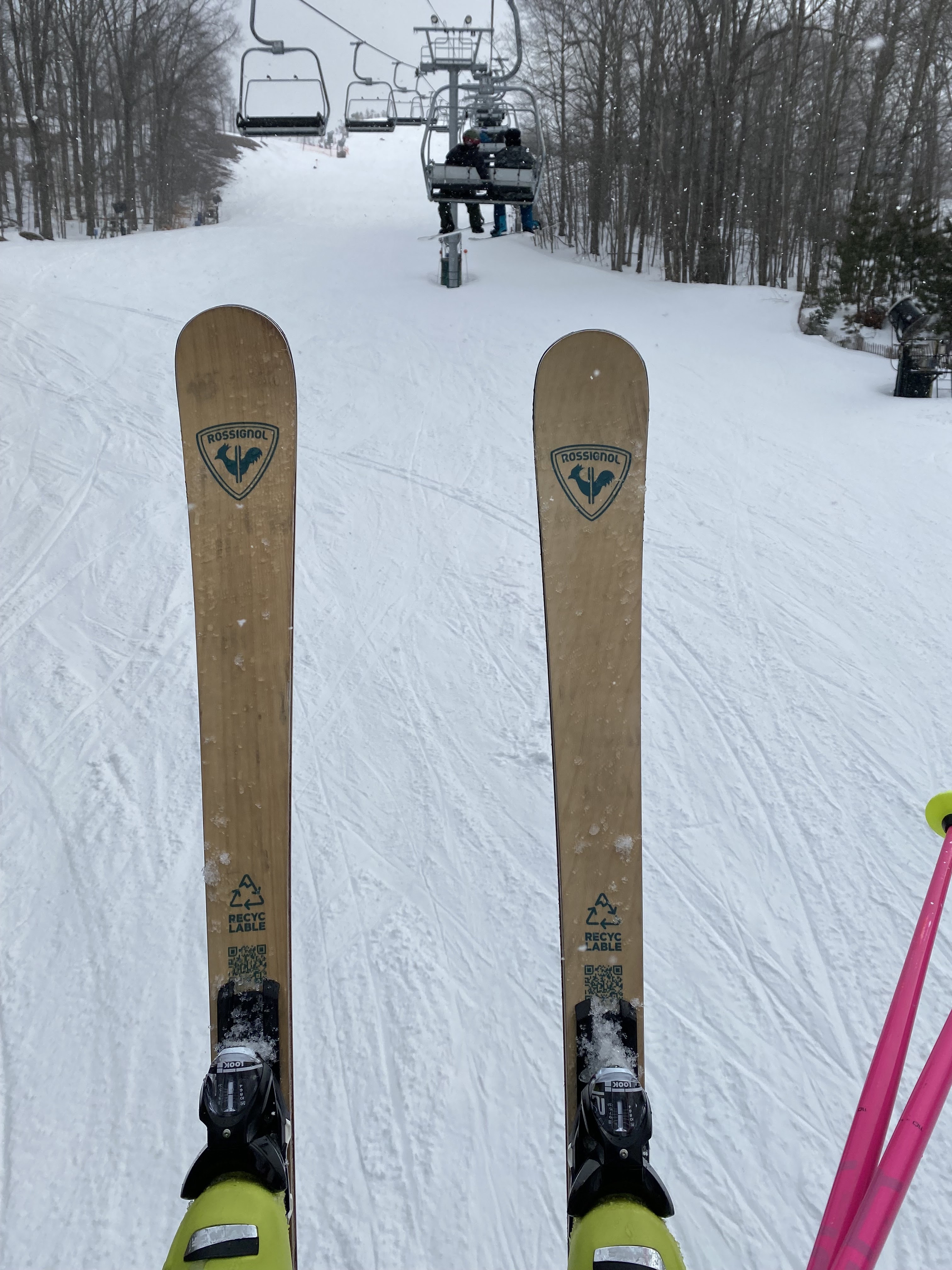
The Essential is Rossi’s attempt to keep skis out of the landfill. It’s made of 72% recycled material, and is 77% recyclable. Buyers are asked to fill out contact info and to return the skis back to Rossi at the end of their life. The top skin is really cool, with a naked wood “lumber yard” look.

This was my last ski for the day and I was skeptical about riding a skinny little slalom race ski on tired legs in the increasingly deteriorating conditions, but Chet said I HAD to try it. I’m SO glad I did!! It was the surprise winner of the day for both of us. I found it to be a zippy yet relaxed short turn specialist with fantastic grip and an easy going nature. It earned almost all 5s from me, with a 4 for medium turns and a 3 in long turns - not surprising given its dimensions. The biggest surprise was that it was the only ski we rode in the afternoon that was absolutely unaffected by the piles of glop. It simply asked to be rolled up on edge and given a touch of tip pressure, then it just cruised through the deep sugar like it wasn’t even there.

This one earned Best in Test from several of us in the demo group. If you get a chance to try it, you simply MUST.